
IMPLEMENTED / CURRENT
LLM Prompt
The llm-prompt behavior uses an external provider installed, wired and configured by the user or integrator. Ravenroot bundles no model and arms no provider by default.
External intelligence · graph-governed control
Connect a provider you choose. Let a prompt step classify or propose. Keep policy, review, actions and outcomes explicit in the graph.
Ravenroot bundles no model. No provider adapter or agent runtime is armed by default. External providers, credentials, egress policy, adapters and runtimes remain choices for the user or integrator.
Generation → deterministic flow
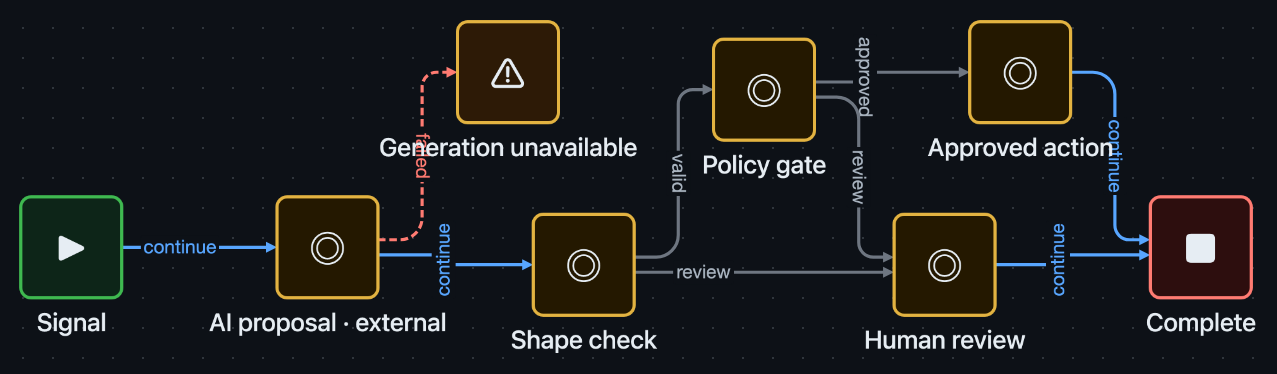
This example routes external model output through user-authored shape and policy checks before any approved action. A human-review path and provider-unavailable path remain visible. The scene does not certify generated output as correct or safe.
What works today
Ravenroot exposes real AI-oriented catalog and authoring surfaces without pretending a model or runtime is bundled.
IMPLEMENTED / CURRENT
The llm-prompt behavior uses an external provider installed, wired and configured by the user or integrator. Ravenroot bundles no model and arms no provider by default.
ARCHITECTURAL CAPABILITY
The agent catalog descriptor exposes a bounded integration seam. Ravenroot ships no AgentRuntime or team-agent runtime; a deployment must supply and register one.
Implemented / current
The Chatbot Assistant can answer about disclosed Ravenroot authoring context. It is read-only: it cannot change the graph or start a run.
Catalog boundary
The catalog contains llm-prompt and agent. There is no distinct Generative AI Actor; “generative” describes a step’s role in the flow.
Architectural extension seam
The real catalog type is agent, not a shipped Team Agent Actor. Ravenroot exposes a bounded seam for an integrator-supplied runtime, while the graph retains lifecycle and review control. Ravenroot ships no AgentRuntime.

Roadmap lab · not current
The knowledge-base service exists, but Ravenroot does not currently ship the product-side MCP client or OAuth callback wiring needed to consult it. Today’s Assistant remains current and read-only without that KB connection.
ROADMAP · NOT AVAILABLE IN THE CURRENT PRODUCT

Providers, credentials, egress rules and optional runtimes belong to the deployment. Ravenroot supplies graph structure, explicit routing and observable boundaries—not a bundled model, an autonomous team or a hidden decision system.
